Personality type compatibility describes how two of the 16 four-letter types tend to interact — where they'll click, where they'll clash — but no pairing system has been scientifically validated to predict relationship success. That doesn't make type talk useless. Used honestly, it's a shared vocabulary for differences you'd otherwise argue about in the dark. Used as a verdict, it will mislead you. Here's how to get the first without the second.
16 personality types compatibility chart
All 16 types, with the three pairings people most often ask about for each one. The columns follow a stated rule rather than folklore, so you can check the logic yourself:
- Easiest fit — same type with the energy letter flipped (E↔I). You process the world the same way and mostly differ in how much social time costs you.
- Complementary fit — shares your information preference (S/N) but differs on energy, decision style and structure. This is the classic "golden pair" shape: enough common ground to talk easily, enough difference to cover blind spots.
- Most translation needed — the opposite on all four letters. Not doomed, and often fascinating, but every conversation crosses four style gaps at once.
Read this as a map of likely friction, not a verdict. No cell in this table predicts whether a relationship will work — see what the research actually says below. A pair in the "most translation" column who talk well will outlast a "complementary" pair who don't.
| Type | Easiest fit | Complementary fit | Most translation |
|---|---|---|---|
| ISTJ The Anchor | ESTJ | ESFP | ENFP |
| ISFJ The Guardian | ESFJ | ESTP | ENTP |
| INFJ The Counselor | ENFJ | ENTP | ESTP |
| INTJ The Architect | ENTJ | ENFP | ESFP |
| ISTP The Craftsman | ESTP | ESFJ | ENFJ |
| ISFP The Composer | ESFP | ESTJ | ENTJ |
| INFP The Idealist | ENFP | ENTJ | ESTJ |
| INTP The Logician | ENTP | ENFJ | ESFJ |
| ESTP The Dynamo | ISTP | ISFJ | INFJ |
| ESFP The Entertainer | ISFP | ISTJ | INTJ |
| ENFP The Spark | INFP | INTJ | ISTJ |
| ENTP The Challenger | INTP | INFJ | ISFJ |
| ESTJ The Director | ISTJ | ISFP | INFP |
| ESFJ The Host | ISFJ | ISTP | INTP |
| ENFJ The Mentor | INFJ | INTP | ISTP |
| ENTJ The Commander | INTJ | INFP | ISFP |
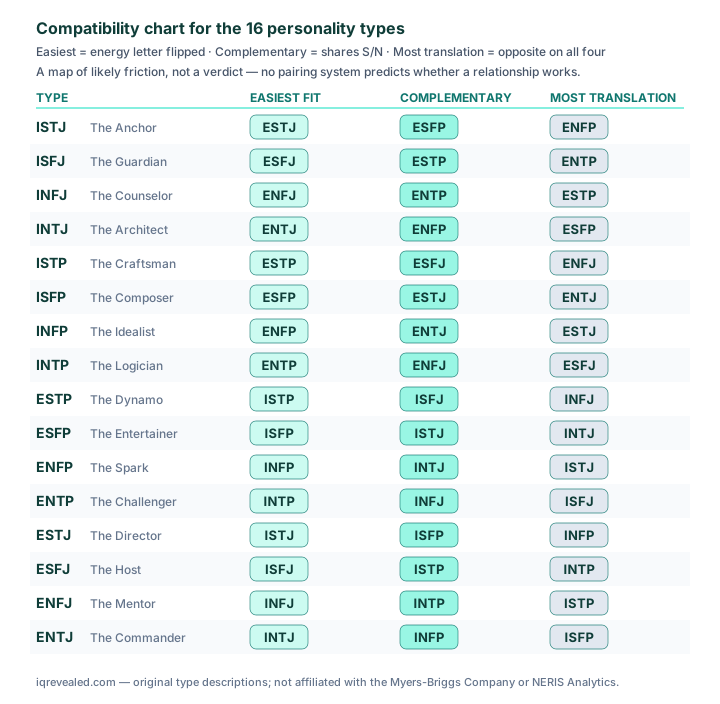
The chart is symmetrical: if ENFP appears as INTJ's complementary fit, INTJ appears as ENFP's. That is a property of the rule, not evidence that the pairing works — it just means the table is internally consistent. Explore any individual type in the 16 type profiles, or see how the Enneagram frames the same question.
IQ Revealed is not affiliated with, endorsed by or connected to the Myers-Briggs Company, NERIS Analytics or any other personality-test publisher. The four-letter codes are widely used descriptive labels; all type descriptions on this site are our own original work.
How compatibility framing works: the four dichotomies
Every four-letter type is built from four preferences: where you get energy (E/I), how you take in information (S/N), how you decide (T/F) and how you organize your life (J/P). Compatibility thinking asks, for each letter: is it better to share a preference or to complement each other? The honest answer is that both patterns cut both ways.
- Shared preferences feel easy. Two J types plan vacations, budgets and Tuesday evenings in happy sync — but may clash over whose plan wins, because both want control of the structure. Two P types never fight about rigidity, and sometimes nobody books the flights.
- Complementary preferences balance — with translation costs. A T–F pair covers more ground: one stress-tests the logic, the other reads the room. But the T must learn that "here's what's wrong with your idea" can land as rejection, and the F must learn that critique of a plan isn't critique of a person. The balance only pays off after the translation work is done.
- E–I differences mostly show up as logistics — how much social time recharges versus drains each person — and are among the easiest to negotiate once named.
- S–N differences are subtler: one partner talks in concrete specifics, the other in patterns and possibilities. Misunderstandings here often masquerade as "not listening."
Compatibility at work vs in relationships
The same difference plays differently depending on the arena. At work, complementary decision styles are usually an asset: teams made up of identical thinkers share identical blind spots, while a mix of T and F deciders, or S detail-checkers and N pattern-spotters, catches more problems before they ship. If you're staffing a project, a colleague who thinks like an ISTJ and one who thinks like an ENFP will annoy each other slightly and cover each other's gaps enormously.
In relationships, the letters matter less than the layer beneath them. Long-term satisfaction tracks shared values, aligned goals and how the pair handles conflict — none of which appears in a four-letter code. Two well-matched types with contempt in their arguments will do worse than two "incompatible" types who repair quickly after fights. Type describes style; relationships run on substance. If you want that substance layer measured rather than inferred, our relationship style test scores how you balance closeness and space, how you communicate and how you handle conflict.
The honest part: what the research actually says
Type compatibility is not scientifically validated as a predictor of relationship success, and the numbers behind that sentence are worth seeing rather than taking on trust.
- Similarity barely matters; the people do. Dyrenforth and colleagues (2010) analysed nationally representative couple samples from Australia, Britain and Germany — more than 20,000 couples. Your own personality and your partner's each predicted relationship satisfaction; similarity between the two added roughly half a percent of explained variance on top. Being alike is close to irrelevant next to who each person actually is.
- What attracts is feeling similar, not being similar. Montoya, Horton and Kirchner's (2008) meta-analysis separated actual similarity from perceived similarity. Perceived similarity predicted attraction consistently; actual similarity predicted it in brief laboratory encounters and stopped predicting it in existing relationships. A chart can tell you two codes match. It cannot make two people feel understood.
- The predictors that do hold are behavioural. Karney and Bradbury's (1995) review of 115 longitudinal studies of marriage found stability tracked how couples handle conflict and stress far more than trait profiles. Gottman and Levenson (2000), following couples for 14 years, predicted divorce timing from how partners behaved during disagreement — not from who they were on paper.
No published pairing chart — not ours, not anyone's — has demonstrated predictive power over who stays happy together. Treat every "golden pair" table accordingly: as folklore with a grain of observational truth, not as measurement. The same caution applies to other typologies people use for matching, from Enneagram types to the pop-culture Type A vs Type B divide. It applies to the four-letter code itself too: our review of how accurate the 16-personalities test is walks through what the test-retest research shows about whether your type even stays the same between sittings.
Common pairings people ask about
INFJ–ENTP
A favorite of compatibility folklore: the reflective, principled INFJ and the restless, debate-loving ENTP. The shared N means conversations go deep fast, and each supplies what the other lacks — grounding versus spark. The friction: the ENTP's devil's-advocacy can read as insincerity to an INFJ who argues only about things that matter. Works when debate stays playful and values stay off the sparring mat.
INTJ–ENFP
The strategist and the spark: INTJs bring long-range structure, ENFPs bring possibility and warmth. Each finds the other genuinely interesting, which counts for a lot. The predictable clash is J versus P — plans versus improvisation — plus the INTJ's blunt T feedback meeting the ENFP's F sensitivity. Negotiable, if named early.
ISTJ–ESFP
Opposites on three letters: the methodical ISTJ and the spontaneous ESFP. At its best, one keeps life running and the other keeps it fun. At its worst, one feels like a parent and the other like a project. The shared S helps — both live in the concrete present rather than in abstractions.
Same-type pairs
Two INFPs or two ENTJs understand each other with almost eerie ease — and share every blind spot. Same-type pairs do fine when at least one partner consciously covers the missing function: someone has to file the taxes, and someone has to ask how everyone's feeling.
How to use type talk constructively
- Use it to describe, never to excuse. "As a P, I plan late — let's set a booking deadline" is constructive. "I'm a P, deal with it" is not.
- Translate before you judge. When a T partner critiques or an F partner takes it personally, name the style difference first and the disagreement second.
- Ask, don't assume. Type describes tendencies, not the person in front of you. Use it to generate better questions — "do you need time alone after work?" — not to skip asking them.
- Retire it when it stops helping. If type talk becomes ammunition in arguments, drop the vocabulary and talk about the specific behavior instead.
The realistic promise of type compatibility is modest and real: not a forecast of who you'll be happy with, but a faster route to understanding the person you've already chosen.