The Enneagram describes nine interconnected personality types — the Reformer, Helper, Achiever, Individualist, Investigator, Loyalist, Enthusiast, Challenger and Peacemaker — each defined by a core motivation and a core fear. Unlike trait models that measure how much of a quality you have, the Enneagram asks why you do what you do. Two people can both be ambitious, but one is driven by a fear of being worthless (Type 3) and the other by a fear of being controlled (Type 8).
What the Enneagram is and where it came from
The Enneagram of Personality maps nine types onto a nine-pointed geometric figure, with lines connecting each type to two others. The modern system was developed by Bolivian teacher Oscar Ichazo in the 1950s–60s and expanded by Chilean psychiatrist Claudio Naranjo, who connected the types to psychological ideas and brought the model to the United States. It spread through spiritual-direction and self-development circles before being popularized in the 1980s and 90s by authors such as Don Richard Riso and Russ Hudson. Today it is widely used in coaching, team workshops and personal development — though, as we cover below, its scientific footing is much thinner than its popularity suggests.
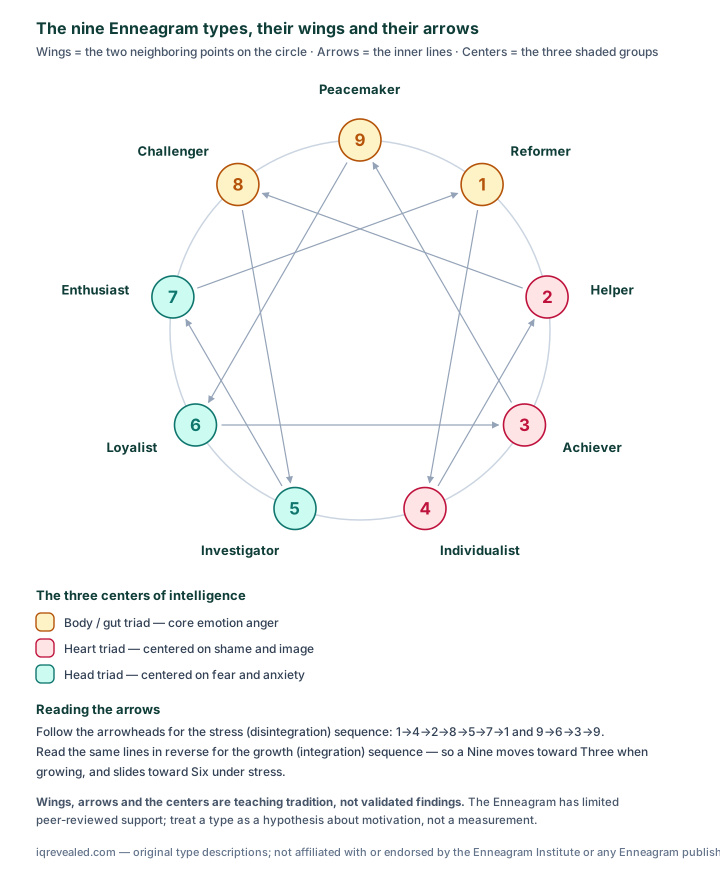
The nine Enneagram types
Each summary below covers the type's core motivation, core fear, what the type looks like at its best, and how it tends to behave under stress.
Type 1 — The Reformer
Ones are motivated by a need to be good, ethical and right, and fear being corrupt or defective. At their best they are principled, purposeful and improve everything they touch. Under stress the inner critic takes over: they become rigid, resentful and perfectionistic, holding themselves and others to impossible standards.
Type 2 — The Helper
Twos are motivated by a need to feel loved and needed, and fear being unwanted or unworthy of love. At their best they are warm, generous and genuinely attuned to others. Under stress their giving becomes strategic — they over-extend, neglect their own needs, and grow possessive or resentful when the care isn't reciprocated.
Type 3 — The Achiever
Threes are motivated by a need to feel valuable and successful, and fear being worthless or a failure. At their best they are adaptable, energetic and genuinely inspiring role models. Under stress image replaces substance: they overwork, cut corners, and lose touch with what they actually want beneath the applause.
Type 4 — The Individualist
Fours are motivated by a need to be authentic and significant, and fear having no identity or personal meaning — being ordinary. At their best they are creative, emotionally honest and able to find beauty in difficult experiences. Under stress they become envious, moody and self-absorbed, convinced something essential is missing from their life that others have.
Type 5 — The Investigator
Fives are motivated by a need to be capable and competent, and fear being helpless, depleted or overwhelmed by others' demands. At their best they are perceptive, innovative and remarkably clear-headed. Under stress they hoard time, energy and knowledge — withdrawing into their heads and detaching from people and practical life.
Type 6 — The Loyalist
Sixes are motivated by a need for security and support, and fear being without guidance in a threatening world. At their best they are committed, responsible and superb troubleshooters who spot risks others miss. Under stress they oscillate between anxiety and suspicion — second-guessing decisions, testing allies and imagining worst-case scenarios.
Type 7 — The Enthusiast
Sevens are motivated by a need to be satisfied and stimulated, and fear being deprived or trapped in pain. At their best they are optimistic, versatile and infectious in their joy. Under stress they scatter: overcommitting, chasing novelty, and reframing every problem as fine rather than sitting with discomfort long enough to resolve it.
Type 8 — The Challenger
Eights are motivated by a need to be strong and in control of their own life, and fear being harmed, betrayed or controlled by others. At their best they are decisive, protective and willing to fight for people with less power. Under stress they become domineering and confrontational, mistaking vulnerability for weakness.
Type 9 — The Peacemaker
Nines are motivated by a need for inner stability and peace of mind, and fear conflict, loss and separation. At their best they are accepting, steady and gifted at mediating between opposing sides. Under stress they go along to get along — numbing out, procrastinating on their own priorities and merging with other people's agendas.
All nine types at a glance
| Type | Name | Core motivation | Core fear |
|---|---|---|---|
| 1 | Reformer | To be good, ethical, right | Being corrupt or defective |
| 2 | Helper | To be loved and needed | Being unwanted or unworthy of love |
| 3 | Achiever | To be valuable and successful | Being worthless or a failure |
| 4 | Individualist | To be authentic and significant | Having no identity or meaning |
| 5 | Investigator | To be capable and competent | Being helpless or depleted |
| 6 | Loyalist | To have security and support | Being without guidance or support |
| 7 | Enthusiast | To be satisfied and stimulated | Being deprived or trapped in pain |
| 8 | Challenger | To be strong and self-determining | Being harmed or controlled |
| 9 | Peacemaker | To have peace and stability | Conflict, loss and separation |
Wings and arrows: how the types connect
Two extra mechanics give the system its texture. Your wing is one of the two neighboring types on the circle that colors your core type — a 4w3 is a more ambitious, image-aware Individualist, while a 4w5 is more withdrawn and cerebral. The arrows are the internal lines of the figure: each type is said to take on healthier qualities of one connected type when growing (a Nine moving toward Three's focused energy) and less healthy qualities of another under stress (a Nine sliding into Six's anxiety). These dynamics are part of the teaching tradition rather than validated findings, but many people find them useful shorthand for how they shift under pressure. The nine types are also traditionally grouped into three centers of intelligence: the body or gut triad (8, 9, 1), whose core emotion is anger; the heart triad (2, 3, 4), centered on shame and image; and the head triad (5, 6, 7), centered on fear and anxiety. If you're torn between types, identifying your center first often narrows the search.
What science says — honestly
Here the balanced answer matters: the Enneagram has limited peer-reviewed validation. A 2021 systematic review in the Journal of Clinical Psychology found mixed evidence of reliability and validity across 104 independent samples. On the positive side, some factor-analytic work lines up partly with the theory, and Enneagram subscales relate to Big Five traits in the directions the theory predicts. Against that: the factor analyses typically recover fewer than nine factors, no study has used clustering to derive the nine types at all, and there is little research supporting the secondary machinery — wings and movement between types. Compared to the Big Five — the trait model with decades of replication behind it — the Enneagram's type boundaries, wings and arrows have little empirical support. Personality also isn't the same thing as cognitive ability: if you want a construct with strong psychometric foundations, that's the territory of how IQ tests work and cognitive ability testing. The same question, asked of the four-letter systems, gets a similar answer for a similar reason — how accurate the 16 personalities test is. The fair verdict: the Enneagram is a self-reflection framework, not a measurement instrument. Its questions — what drives you, what are you avoiding — are genuinely useful prompts even if the nine boxes are not scientifically settled categories.
How to use the Enneagram well
Treat your type as a hypothesis, not a verdict. Read two or three type descriptions that feel close and notice which core fear stings most when you read it — motivation is the sorting key, not behavior. Use the insight to spot your autopilot patterns at work and in relationships, and pair it with frameworks that measure something different: the older Type A vs Type B distinction describes your pace and stress style, the 16-type compatibility chart maps how four-letter types tend to get along, and interest-based tools help when you're weighing a career change. If the autopilot pattern you keep spotting is a relationship one, a relationship style test measures it directly — closeness, communication and conflict. No single lens captures a person; the Enneagram earns its place as one of several.
IQ Revealed is not affiliated with, endorsed by or connected to the Enneagram Institute or any other Enneagram publisher or training body, and does not administer or score their instruments. The type numbers are common to every Enneagram tradition, but the names used here — Reformer, Helper, Achiever, Individualist, Investigator, Loyalist, Enthusiast, Challenger and Peacemaker — are the Riso–Hudson names published by the Enneagram Institute, and other schools name the nine types differently. They are used here only so that the material this guide describes can be traced back to where it comes from. The wording of the type descriptions above, and the drawing of the figure, are our own.